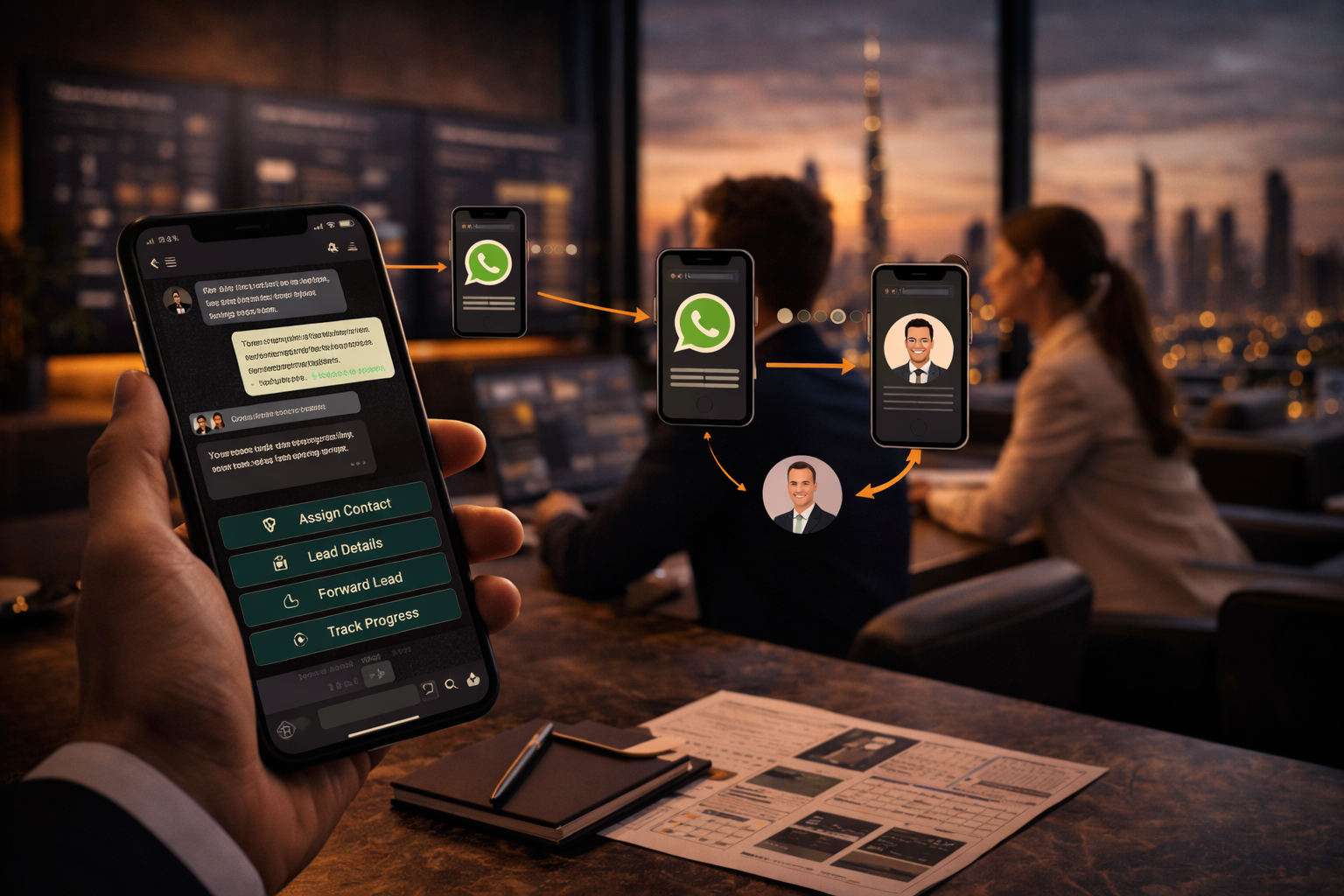
WhatsApp automation in Dubai is often discussed as if it were mainly a convenience feature. In practice, it is much closer to response speed, lead control and operational discipline. A prospect clicks from Google Ads, a service page or a landing page, opens WhatsApp, asks a direct question and expects the business to react quickly. If the reply is slow, inconsistent or lands with the wrong team member, the problem is not the channel. The problem is the workflow behind it.
That is why the best WhatsApp automation projects do not start with "everything the tool can do". They start with one operational bottleneck that is already costing money. In Dubai, that usually means a slow first reply, unclear handoff after the first message, weak confirmation flow, or repeated reminder work that staff keep doing manually.
Why WhatsApp automation matters so much in Dubai
Many businesses in Dubai still treat WhatsApp as a side inbox. That is usually a mistake. For many service categories it is the real first point of contact. Real estate enquiries, clinic follow-up, hospitality requests, concierge questions, premium service consultations and post-ad-click conversations often move into WhatsApp faster than they move into email or long-form enquiry systems.
That creates a simple commercial reality: if WhatsApp is where the conversation starts, then WhatsApp is also where trust can be won or lost first. A delayed reply feels expensive. A vague answer feels careless. A handoff that disappears between people feels disorganized. Automation matters because it protects those first moments without forcing the team to type the same messages all day.
Best first use cases
The strongest starting points are usually first response to new enquiries, appointment or booking confirmations, reminders before key actions, and routing conversations to the right team member. These use cases work well first because they already sit at the point where manual repetition is obvious and where delay damages the customer experience fastest.
Where businesses usually see ROI first
The strongest early use cases are rarely complicated. They are usually the places where speed matters most and repetition is already obvious. For many Dubai businesses, that means first response to new enquiries, appointment or booking confirmations, reminders before key actions, and routing conversations to the right person or department. Those are the points where a delay hurts trust, lowers conversion and creates extra manual work inside the team.
First response is usually the clearest win. A business does not need a robotic sales conversation on day one. It needs a fast, clean opening message that confirms receipt, sets expectations and keeps the lead warm until a human takes over. Confirmation flows are another strong starting point because they remove ambiguity. If someone has booked, requested a callback or submitted a consultation enquiry, the next message should not depend on whether a staff member remembered to send it.
Reminders are also a practical first layer because they protect intent that already exists. The customer has already shown interest. The business now needs to reduce drop-off before the next step. Routing is the fourth major win because many WhatsApp problems are not message problems at all. They are ownership problems. The enquiry arrives, but nobody is clearly responsible for what happens next.
Why these work first
These workflows tend to produce value early because they sit where response speed, clarity and ownership matter most. A slow first reply weakens conversion. A missing confirmation creates doubt. A forgotten reminder lets warm intent cool off. A weak routing step leaves the whole team guessing who should act next. Automation works first where manual inconsistency is already visible and expensive.
What a stronger setup usually improves first
A good WhatsApp automation setup should not feel like noise. It should move the conversation into a clearer operational structure. In practice, that usually means faster first response, better confirmation after enquiry or booking, cleaner reminders before appointments or deadlines, and more consistent routing by service, language, location or team.
For Dubai businesses, language-aware handling often matters earlier than expected. If the lead should be handled in Arabic, the workflow should know that quickly. If the request belongs to a different team, branch or service line, that should also be visible early. The value of automation is not only that a message gets sent. The value is that the next step becomes harder to lose.
Why narrow use cases work better than "full automation"
Many teams make the same mistake when they first look at WhatsApp automation. They try to design a complete end-to-end system before they have proved one useful workflow. That usually slows the project down and creates more edge cases than the business is ready to manage.
The strongest projects start narrower. One lead source. One service line. One reminder flow. One confirmation path. One routing rule. That smaller scope makes it easier to measure what improved and where the next layer should go. It also keeps the team involved, because staff can see the change in daily work instead of hearing abstract promises about automation.
What to measure before and after launch
If a business wants real ROI from WhatsApp automation, it has to measure more than message volume. The useful numbers are usually time to first reply, number of missed or unowned leads, volume of repeated manual replies, confirmation completion rate and visibility into who owns each conversation after the first contact.
Those metrics matter because they connect automation to business performance. A workflow is only useful if it reduces drop-off, protects response discipline or saves repeated manual effort. If the system sends messages but the team still has poor ownership, weak visibility or delayed follow-up, then the automation layer is not solving the real problem yet.
What to measure
Before building automation, it is worth tracking a small set of numbers clearly: time to first reply, number of missed leads, volume of repeated manual messages and owner visibility across conversations. Those measures show whether the workflow is actually improving response discipline and reducing manual friction, rather than just adding another layer of tooling.
Why internal handoff matters as much as the customer message
Many WhatsApp automation discussions focus only on what the customer sees. That is incomplete. The internal side of the workflow matters just as much. A business may send a fast first reply and still fail operationally if the lead is not assigned, the next step is unclear or the team cannot see what has already happened.
This is especially important in Dubai businesses where multiple languages, service lines and sales paths can overlap. The customer experience may begin in WhatsApp, but the business outcome depends on whether the team has a clear handoff. Automation becomes valuable when it connects the front-end message with the internal owner, next action and service context.
Keep it practical
The best WhatsApp automation projects start narrow, measure impact and only then expand to more workflows. That is usually more effective than trying to automate every conversation type from the start.
Best starting point for most businesses
The most practical starting point is usually the first-response layer for new enquiries. It is easy to feel the pain there, easy to measure, and easy to improve without redesigning the whole operation. Once that works, the next sensible layers are confirmation flows, reminders and routing logic. That sequence tends to create faster ROI than trying to automate the entire WhatsApp journey in one move.
The best WhatsApp automation in Dubai is not the most complex system. It is the one that removes the biggest operational delay first, gives the team clearer ownership and creates a smoother customer path from the first message onward.